Nobody Handed Me the Door: Navigating an Industry That Wasn't Designed With You in Mind

Let's be honest about something upfront: the American entertainment industry was not built with everyone in mind. That's not a cynical take — it's just history. The infrastructure, the gatekeepers, the unwritten codes of networking and access — all of it developed in an era when the range of acceptable faces, voices, and stories was staggeringly narrow. Some of that has changed. A lot of it hasn't.
For artists navigating that landscape today — especially those from South Asian backgrounds, or anyone whose identity places them outside the traditional center of gravity — the path forward rarely looks like the path that's been written about. It's messier, more circuitous, and honestly more interesting than the standard Hollywood mythology suggests.
This isn't a piece about waiting for the industry to change. It's about what you actually do while it's changing.
The Room Where You're the Only One
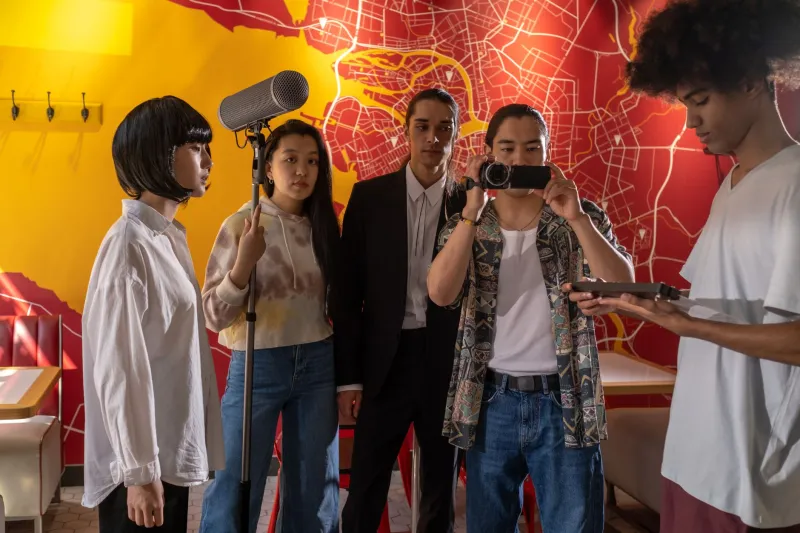
Almost every artist who's broken through from an underrepresented background can describe a specific flavor of experience: walking into a networking event, a pitch meeting, a workshop, or a set and realizing you're the only person in the room who looks like you. It's a particular kind of awareness that doesn't fully go away, no matter how many times it happens.
What changes is what you do with it.
Some artists spend energy trying to minimize that awareness — code-switching, softening, making themselves easier to categorize for the people in the room. That's understandable. It's also, in the long run, exhausting and counterproductive. The artists who tend to build sustainable careers have figured out a different move: they use that visibility as information.
Being the only one in the room tells you something real about the room. It tells you where the gaps are. It tells you what stories aren't being told yet, what perspectives are missing from the conversation, what audiences are being underserved. That's not a liability. That's market research.
The reframe matters. You're not the outsider who snuck in. You're the person who can see what everyone else is too comfortable to notice.
Rejection Is a Data Point, Not a Verdict
Every working artist has a rejection story. The ones who keep going have figured out how to hold those stories differently.
Here's the thing about rejection in an industry that wasn't built for you: sometimes it's about your work, and sometimes it has absolutely nothing to do with your work. A casting director who can't picture a South Asian actor in a particular role isn't giving you feedback on your craft — they're revealing the limits of their imagination. Those are different problems requiring different responses.
Learning to tell the difference is genuinely hard, and it takes time. But it's one of the most important skills an artist can develop. When a rejection reflects something real about your preparation, your material, or your readiness — take it seriously. Sit with it. Let it teach you something. When a rejection reflects someone else's inability to see past their own assumptions — note it, move on, and find the people who can actually see you.
The worst thing you can do is internalize a verdict that was never really about you. The second worst thing is dismissing every rejection as someone else's problem. Honest self-assessment, without self-destruction — that's the needle you're threading.
Building Your Own Platform When Traditional Doors Stay Closed
One of the most significant shifts in the entertainment landscape over the last decade has been the rise of independent platforms — YouTube, podcasts, short-form video, self-distributed film — as legitimate launching pads for serious careers. This isn't news. But it's worth saying clearly: for artists from underrepresented backgrounds, this shift has been genuinely transformative in a way it hasn't always been for everyone.
When the traditional gatekeepers aren't opening doors, building your own platform isn't a consolation prize. It's a strategy.
What that looks like practically: creating consistent work, even when the audience is small. Documenting your process in ways that invite people into your creative world. Building a community around your perspective, not just your output. The artists who've leveraged independent platforms most effectively aren't treating them as a waiting room for their "real" career — they're treating them as the career, at least for now, and letting the results speak.
The other thing independent platforms give you is something the traditional industry rarely does early on: ownership. Over your narrative, your image, your work, your relationship with your audience. That's not a small thing. It's the foundation everything else gets built on.
Networking When You Don't Know the Rules
Conventional networking advice was written for people who already fit the default mold — people for whom showing up at the right events, dropping the right names, and playing the right social games is a relatively frictionless experience. For everyone else, that advice ranges from mildly unhelpful to actively counterproductive.
What actually works, based on what artists who've navigated this successfully tend to describe, is something simpler and more human: genuine connection over transactional relationship-building.
Find the people who are interested in what you're actually interested in, not just the people who are useful. Be generous with your attention, your time, and your knowledge — especially with other emerging artists who are figuring it out alongside you. The entertainment industry runs on relationships, yes, but the relationships that last are the ones built on real mutual respect, not calculated positioning.
Also: find your people outside the obvious rooms. Some of the most valuable connections happen in unexpected places — a community theater production, an online forum, a cultural festival, a local open mic. The gatekeepers at the top of the industry aren't the only people worth knowing. The emerging directors, writers, and producers who are building alongside you right now are going to be running things in ten years. Invest in those relationships.
The Unconventional Timeline Is Still a Timeline
American entertainment mythology loves a certain kind of origin story: the overnight discovery, the big break, the moment everything changed. It's a compelling narrative, and it occasionally happens. But it's not the story for most working artists, and it's almost never the story for artists who built careers without the tailwind of industry infrastructure designed to support them.
The unconventional path is longer, more nonlinear, and often more privately sustained than the highlight reel suggests. There are years of work that don't get seen. There are pivots that look like failures from the outside. There are moments of genuine doubt that don't make it into the retrospective interviews.
What matters is the accumulation. Every role, every project, every platform post, every connection, every rejection processed and set aside — it compounds. The career that looks like it appeared suddenly is almost always the visible tip of a long, invisible iceberg.
The art, the story, the legend — none of it gets built in a single moment. It gets built in the thousand small decisions you make to keep going when the industry gives you every reason not to. That's the work. And it's worth doing.