Feeling It Isn't Enough: The Technical Craft That Actually Makes a Performance Land on Camera
The Lie We Tell Ourselves on Set
There's a version of acting advice that gets passed around like gospel — find the truth, feel the moment, let it be real. And look, none of that is wrong exactly. Emotional authenticity matters. But here's the thing nobody says loudly enough in acting school or on set: the camera does not care about your internal journey. It captures light, angles, and spatial relationships. And if your technically perfect emotional breakdown is happening three inches outside the frame, it doesn't exist.
This isn't cynicism. This is craft. And the actors who figure it out early are the ones who build long careers.
What the Lens Actually Sees
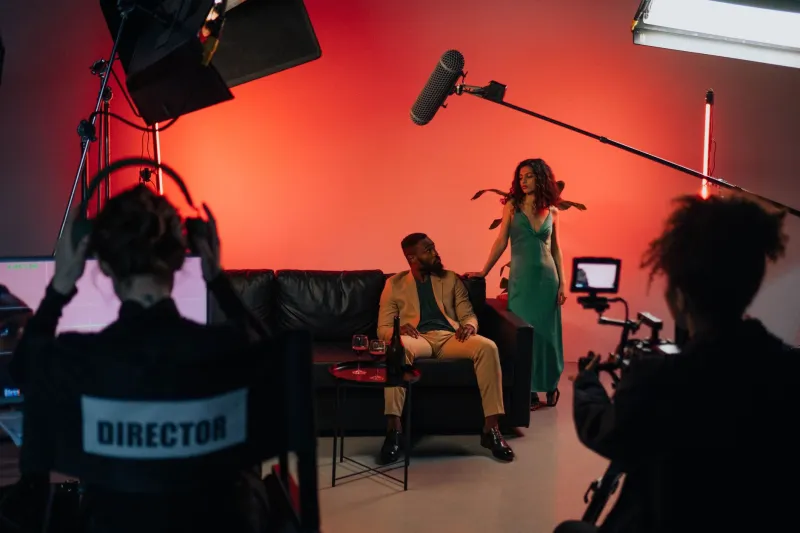
A camera is a machine with a very specific point of view. It has a frame — a defined rectangle of reality — and everything outside that frame is invisible to the audience. Directors and cinematographers spend enormous amounts of time designing what lives inside that frame. Lighting rigs are built to hit specific marks. Focal lengths are chosen to compress or expand depth. And all of that technical architecture assumes the actor is going to show up and work within it.
When an actor drifts off their mark, even slightly, they can blow out of the key light. Their face goes dark. Or they step in front of another actor's eye-line, flattening the composition. The emotional work might be genuine — maybe even brilliant — but the technical failure swallows it whole.
The best screen actors understand this intuitively. Tom Hanks has talked about it. Meryl Streep is famously precise about her positioning. These aren't robots suppressing emotion — they're craftspeople who have trained themselves to feel deeply and hit the mark at the same time. That combination is the actual skill.
Eye-Lines: The Invisible Architecture of Connection
Here's one of the most underrated technical elements in screen performance: the eye-line. Where you're looking when you deliver a line, when you listen, when you react — all of it communicates relationship and geography to the audience in ways they process unconsciously.
In a two-person scene shot with standard coverage, your scene partner might not even be standing where they appear to be on screen. They could be just off-camera, or replaced by a script supervisor holding a piece of tape at eye level. The audience will believe the connection is real only if your eye-line is correct and consistent across every take and every setup.
When actors cheat this — when they look slightly wrong because it feels more natural to them in the moment — the audience senses something is off without being able to name it. The scene feels vaguely disconnected. The emotional stakes deflate. And it's not because the performance wasn't felt. It's because the technical execution didn't support it.
Blocking Is a Conversation, Not a Cage
A lot of actors, especially those coming from a heavy theater or method background, treat blocking like an inconvenience. Something the director imposes on the real work. But blocking on a film or TV set is actually a sophisticated visual language — and understanding it changes how you approach a scene entirely.
When a director blocks two characters far apart in a wide shot, that distance is communicating something. When they push in to a tight close-up for a single line, that choice amplifies weight. The actor who understands this can lean into the visual grammar, using the blocking to deepen the emotional moment rather than fight against it.
One practical example: if you're being shot in a tight close-up, the smallest physical impulse reads enormous. A jaw tightening. A breath held a half-second too long. Actors who are used to projecting for a stage, or who are so deep in emotional experience that they're moving freely through space, often over-perform in these moments. They blow the scene not because they weren't feeling it, but because they didn't adjust their scale to the frame.
The On-Set Reality Nobody Romanticizes
Here's the unglamorous truth: film sets are not emotionally ideal environments. You might shoot your most devastating scene at 2 a.m. after fourteen hours of waiting. The crew is tired. The director is behind schedule. And you have exactly three takes before they have to move on.
In that environment, an actor who relies entirely on summoning authentic emotional states is at a serious disadvantage. Because the conditions are not set up to nurture your emotional process — they're set up to capture images efficiently. The actors who thrive are the ones who have built technical reliability into their bodies. They can hit the mark, find the eye-line, adjust their scale to the lens, and still access something genuine, because the technical work is automatic enough that it doesn't compete with the emotional work.
Think of it like a musician. A guitarist who has to consciously think about chord fingering can't also be fully present in the feeling of the song. But once those chord shapes live in muscle memory, the technical and the expressive operate simultaneously. Acting works the same way.
Building the Foundation Without Losing the Soul
None of this is an argument against deep emotional preparation. The internal work absolutely matters. Character history, relationships, stakes — all of it feeds the performance in ways the audience feels even when they can't articulate why. But that internal architecture needs to be built on top of technical fluency, not instead of it.
The most effective approach is to treat technical rehearsal as seriously as emotional rehearsal. Walk the blocking until it's in your body. Practice finding your marks without looking down at the floor. Study the shot list so you understand what the camera will see. And then, once all of that is locked in, let it go and be present in the scene.
The camera knows when something is real. But it also knows when something is technically off. The goal is to give it both — the authenticity and the craft — so that what reaches the audience is the full, complete thing you intended.
That's the work. Not one or the other. Both, at the same time, every single take.