When Showing Up Means Showing Off: The Hidden Trap Inside Every Audition Room
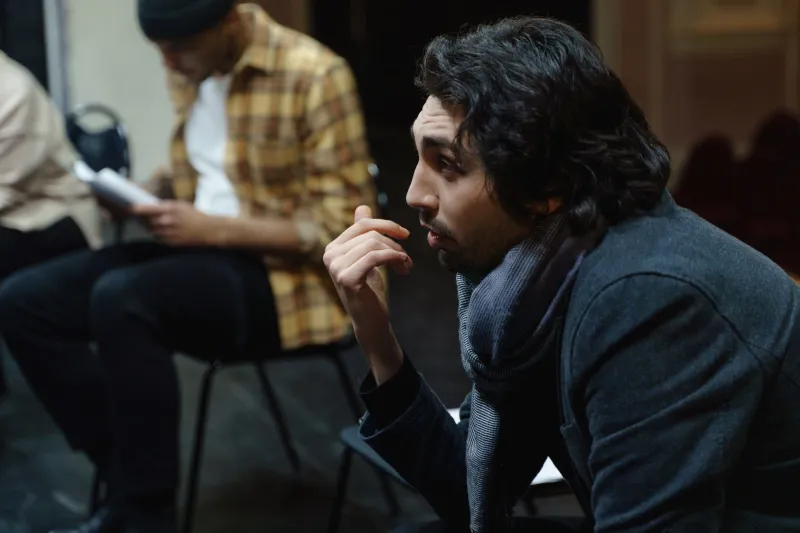
The Room That Changes Everything
You've done the work. You've run the sides a hundred times, found the emotional truth, made bold choices. You walk into that waiting area in Midtown Manhattan or off a side street in Burbank, and somewhere between signing in at the front desk and hearing your name called, something shifts.
You stop being yourself.
Not dramatically. Not in a way that's easy to spot. But there's a version of you that steps into that room — polished, eager, slightly louder than necessary — and it's not quite the same person who does their best work at 11pm in a cramped rehearsal space or on the third take when the camera crew has stopped watching so closely. That gap, that distance between who you perform yourself to be versus who you actually are as an artist, is one of the most underexamined problems in the craft.
And it costs people jobs every single day.
The Performance Before the Performance
Here's the paradox nobody really talks about: auditions reward a specific kind of confidence that isn't always the same as genuine artistic confidence. The room wants you to project certainty, readiness, magnetism — all in the span of about ninety seconds before you even open your mouth to read. So performers learn, consciously or not, to manufacture that energy.
You start performing the idea of yourself as a performer.
It's not dishonesty, exactly. It's survival instinct dressed up as professionalism. The industry has trained actors, musicians, and creatives to present a curated front because the casting process, as it's traditionally structured, rewards the appearance of ease over the reality of depth. Callbacks go to the person who seemed the most comfortable, not necessarily the one with the most nuanced read.
But here's what's tricky: casting directors — especially the good ones — can feel the difference. They've sat through thousands of these sessions. They know what manufactured magnetism looks like. And while it might get you in the door, it rarely gets you the role that actually fits.
Why the Best Actors Struggle the Most
Counterintuitively, the artists who have done the deepest character work are often the ones most prone to this trap. Why? Because they've developed a rich interior life for their craft — layers of vulnerability, complexity, genuine uncertainty — and then they walk into an audition and feel pressure to compress all of that into something immediately legible and sellable.
Deep work doesn't always read fast. Real presence isn't always loud. And the audition room, with its fluorescent lighting and folding chairs and someone typing notes on a laptop while you're mid-monologue, isn't exactly designed to invite the slow, generous unfolding that great performance actually requires.
So the artist overcompensates. They push. They indicate. They play the emotion instead of living inside it, because living inside it feels too quiet, too subtle, too risky when you have four minutes to make an impression.
The result? A performance that looks like acting. Which is, ironically, the last thing anyone in that room actually wants to see.
Breaking the Pattern Without Blowing the Audition
So what do you actually do about it? A few things worth considering — not as rules, but as genuine reframes.
Let the room be awkward. One of the biggest mistakes performers make is trying to smooth over the natural strangeness of the audition dynamic. The silence before you begin, the moment of adjustment, the beat where you're just standing there — these don't need to be filled. Letting them exist, without rushing past them, is itself a signal of presence. It says: I'm not afraid of this space.
Stop trying to be likable and start trying to be specific. Likability is a trap. It's a diffuse quality that reads as generic warmth, and generic warmth is forgettable. Specificity — a particular way of holding your body, a very precise emotional logic, a choice that's clearly yours — is what makes someone lean forward. You don't need them to like you. You need them to find you interesting.
Rehearse the transition, not just the material. Most people prepare their sides obsessively and give zero thought to what happens in the thirty seconds before they start. That transition — walking in, greeting the room, settling into the space — is where the manufactured self tends to take over. Practice that part. Not to make it slick, but to make it honest. Know how you actually want to enter a room, not how you think you're supposed to.
Give yourself permission to not want the job. This sounds like bad advice. It isn't. Desperation has a smell. When you're auditioning from a place of I need this, your body tightens, your choices narrow, and you start playing to the room instead of playing the scene. The mental shift of I'm here to show you something, and whether it fits is a conversation we're having together — that reframe changes your physical presence in ways that no amount of technique can fake.
What the Room Is Actually Asking For
Here's the honest truth about what casting is looking for, stripped of all the mythology: they want to know if you can be trusted. Trusted to show up, to collaborate, to bring something genuine into the room every single day of a shoot or a run. The audition is a proxy test for that trustworthiness.
And nothing communicates trustworthiness like authenticity. Not polish. Not energy. Not how well you've memorized the sides.
The artists who book consistently — not the one-offs, but the ones building real careers — tend to be people who've figured out how to walk into that room as themselves. Not a diminished, anxious version of themselves, and not a pumped-up performance of confidence they don't actually feel. Just themselves: curious, prepared, willing to be seen.
That's the work underneath the work. And it's harder than memorizing any script.
The Long Game
If you're early in your career, this might feel abstract. But give it time. The performers who are still doing interesting work ten, fifteen years in — they've almost universally figured out this piece. They stopped auditioning as a version of themselves and started showing up as the actual thing.
The legend isn't built in the room where you're trying to impress someone. It's built in all the rooms before and after — where you're doing the real work, finding the real thing, becoming someone worth casting not because you performed it well, but because it's genuinely true.
That's the art. That's the story. And it starts with being honest about who's actually walking through that door.